|
Leo is a serious experiment |
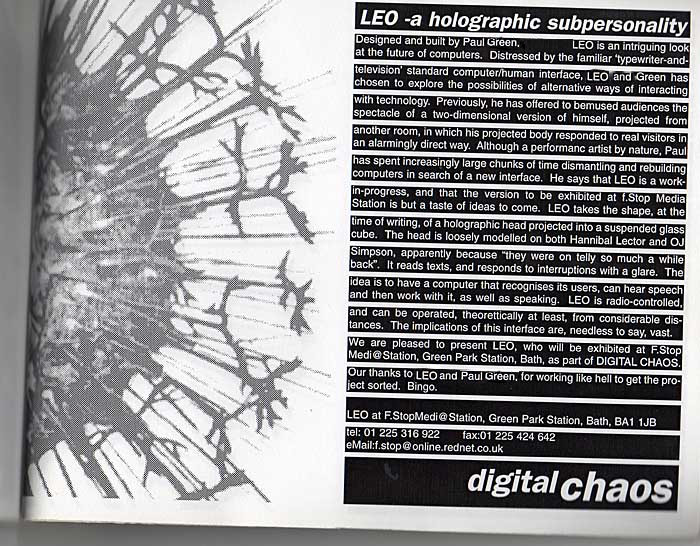
First introduced to a forgiving audience at the, International Cyber Conference, Bath,UK June '96 (digital chaos) (c) paul green 1995 |
|
| . |
|
Leo is a serious experiment |
First introduced to a forgiving audience at the, International Cyber Conference, Bath,UK June '96 (digital chaos) (c) paul green 1995 |
|
|
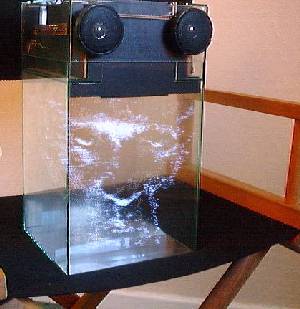
LEO Photographed in 1999. Much of the voice recognition is now resolved , due in part to the leaps and bounds made in recent years by Dragon, Philips and IBM. There is no point re-inventing the wheel! There is however some of the original system in place for other reasons. The original plates are beginning to fade but the original 'concept' seems to still hold water. The translucent effect seems more realistic than other approaches. And the 3D effect adds to this. Seeing is believing....is it? I suspect it is not what the eye sees that it believes more of what the mind expects. I would have to wouldn't I, for to believe that was what I was seeing would make them exist... for me anyway! To see what I am getting at you have to watch Sesame Street, The Muppets or a ventriloquist. A dialogue with a piece of fabric over someone's hand does not, on the face of it, seem like a very rational scenario. However it does work in practice, for most people (why I have no idea). So can this be taken one step forward? At what point does the illusion begin to degrade. Leo plays at that subconscious level at that point at which we believe inanimate objects possess a presence, an independent awareness or consciousness, provided the basic parameters are observed.This may seem quite ridiculous at first sight, but there is much that we do that is quite irrational. Reason can only get you so far when wishing to replicate human interactions, especially with synthetic systems. To give an example: a muppet baby character is given a bottle of Whisky to drink by an adult presenter. What reactions does that stir? That it is ridiculous for a stuffed puppet to drink or the moral outrage of a young anything (if that is what it is) being given Whisky by a responsible adult? I would be very surprised if most people didn't at least feel the latter to some degree. The complexity of our actions/reactions do contain such seeming paradoxes. there will be more soon!So did it work, you ask, did that glass box 'engage' with the audience? Thankfully it did, possibly more because the assembled could see where I was going with it. It did work though I have to say. The moment at which LEO declared 'Well if you're all going to talk I'll wait until you've finished' had the same effect as a headmaster in assembly. What was happening was an engagement, LEO had taken on a presence, a position of existence within the group. Hands up, the response sentence was, in this case, one I had pre programmed, and wasn't spontaneous from LEO's 'mind'...but that's just a technicality, I can easily make things like that happen spontaneously...with some further development. No LEO achieved all I'd hoped...even with the background interference of the pub's cooling system. LEO existed, people gave him personal space, no-one tried to touch him or look round the back. No-one asked how it all worked...the technical stuff (which was a surprise) they just accepted him as a 'him'. So now the hard work of building up his memory, a virtual friend, self, companion, PA, and 'front line' to my personality. Hook him into my phone calls, emails, web browsing and my muses along country walks. Not to mention my political, religious and personal beliefs. No more will I need to 'remember' anything because LEO won't forget. How many million pieces of imformation at his disposal before you can't tell him from me? I wonder? |
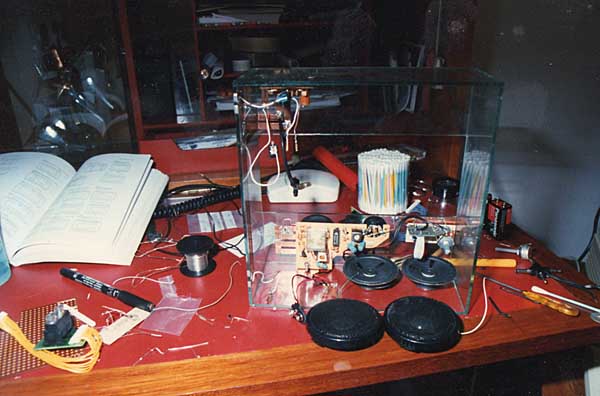
The speakers are very crude I admit, they are efficient though! Leo sits in a room reading a story, observers in the room may listen or move around at will. However should they speak loudly in his proximity, he stops reading, looks up and declares " I cannot continue if you will interrupt me!"The reaction is quite dramatic, the conflict between social convention and belief of Leo's 'personality' override the option to dismiss the inanimate object. This 'experiment' proposes some unusual conclusions.
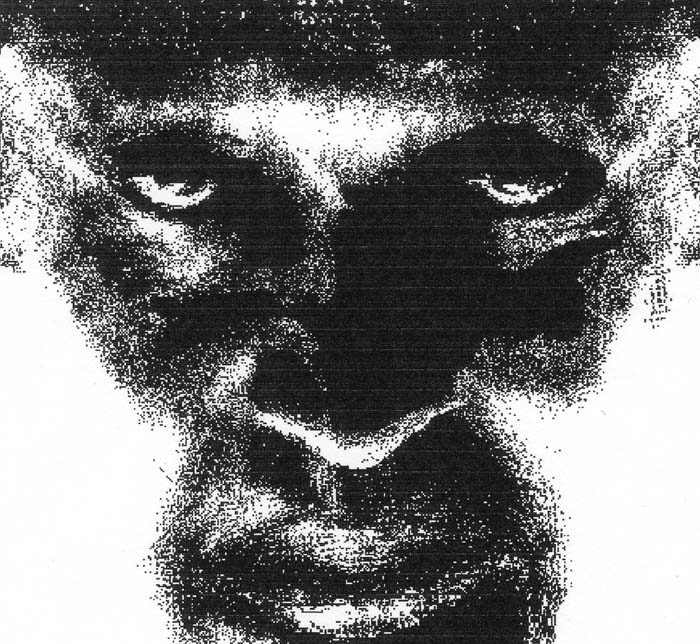
The original image built up from single black pixels.
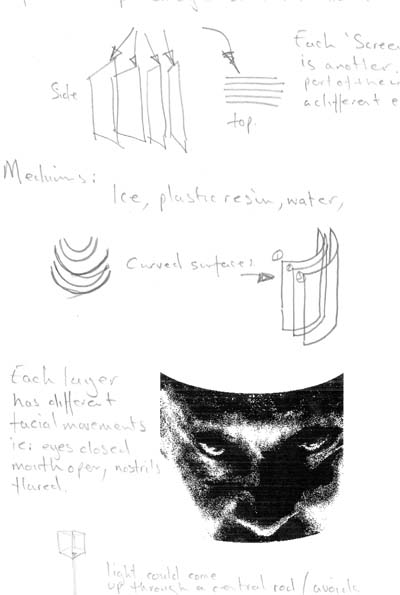
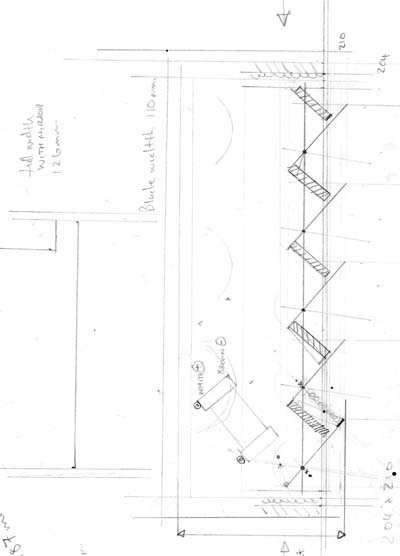
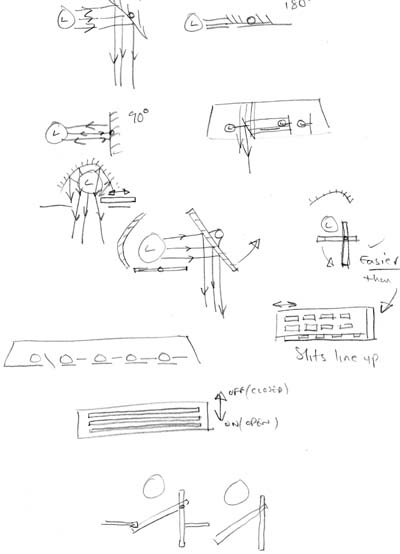
How the 3D image was constructed: 5 Acetate 'plates' were printed with an image of LEO. Each image represented different aspects of facial expression. The images were printed onto transparent plates with Ultra violet sensitive ink. Once dry each plate appeared transparent in normal light, but when an Ultra violet light was shone on them the face glowed blue. I achieved this 'printing' by modifying an inkjet printer cartridge (Canon BJ10) and filled it with the ultra violet ink. Luckily it printed! I had, of course, first coated the acetate sheets with a layer of hair lacquer onto which the ink could adhere. original drawings from 1996:
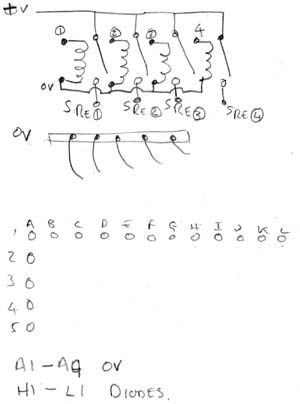
How the 'Light Box' worked: The light box was a mirror box containing 3 UV light sources. The UV tubes are illuminated constantly. Above each of the hanging 'plates' is a light trap operated by a electro magnet. These 5 trap doors are operated in sequence, controlled by the computer program to synchronize with facial movements needed as the synthesized 'speech' operates. The image below is a gif build which shows the plates in action:
The effect is created by each plate being transparent until illuminated from above. The head appears pseudo 3D.
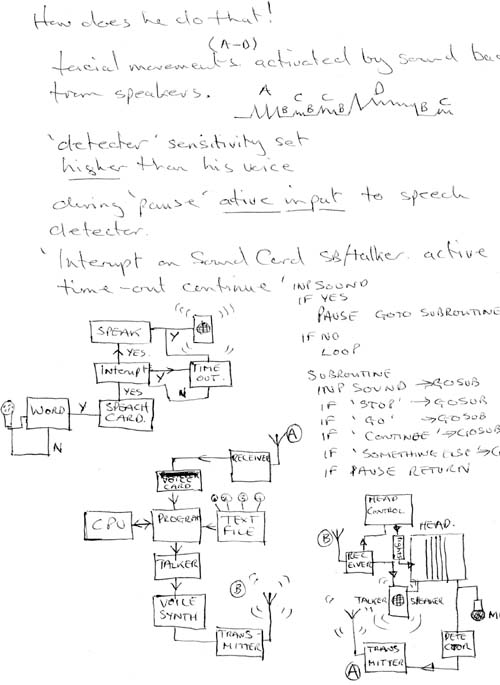
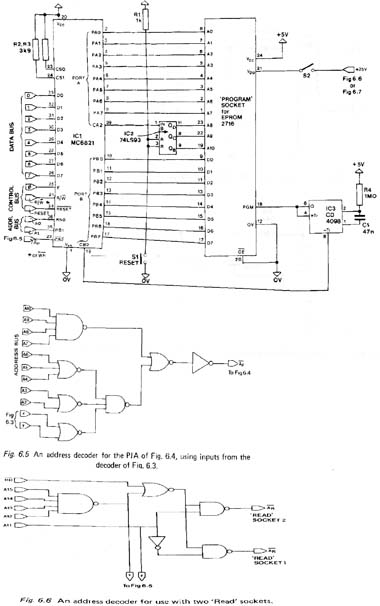
A Basic flow diagram of how the system works. Control of LEO the Head: Leo is a remote system, all processing of information was carried out by a computer connected via radio control. The circuitry in LEO is (sorry I'm keeping that bit) currently operated by an audio power meter that triggers relays that in turn 'fire' and hold the solenoids in the light box. The frequencies are used to give the different movements. Sub routines in the program send audio frequencies that correspond to the actions, even though the actual 'words' don't. Leo's voice is an audio radio receiver, which transmits synthesised audio from the 'Soundblaster' output from the control computer. Transmission from Leo: Leo has dynamic microphones which pick up speech from anyone in the proximity of him as transmits them back to the control computer which processes the sounds. Processing signals from LEO:
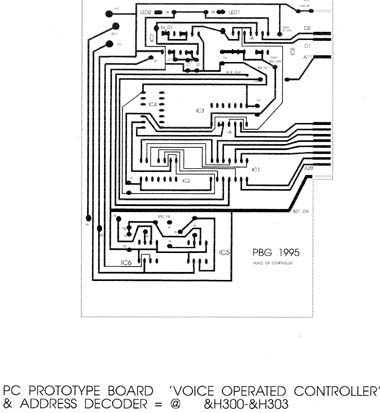
The control from LEO's head is processed by this address decoder and ISA prototype board. The Input to the board is a radio receiver from the head. The received signals are processed through a machine code program which interprets word 'patterns' and compares them with a database. In essence this is a voice recognition board. Some basic ideas from the time 1996, to achieve this:
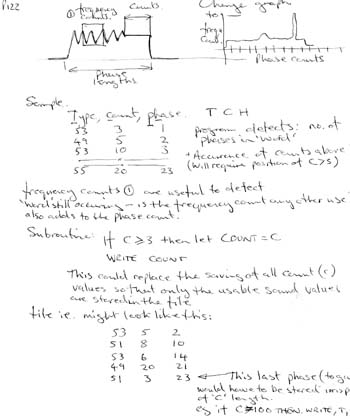
Programming in BASIC: The address decoder is controlled by a BASIC program which processes the received speech by 'sampling' the signal at high speeds. The word patterns can then be more to that of the subject* * The intended speaker is LEO's sub personality, so the idea is for LEO to 'bemome' a virtual version of that sub personality.
The casing is all glass, I wanted the unit to be as invisible as possible...though it wasn't quite so easy. |
| The Process is concerned with many interpretations of current technology, sociology and philosophy. In particular experiments into alternative interactive systems. Whenever possible we would like to share the results of these investigations with all, although it must be stressed this work does represent a very large investment by many people. Therefore we welcome comments, collaborations and ideas and hope it will stir the imagination but all material remains the copyright of , The Process. |